
Who Settled Washington Ontario?

Jenny Harvey, local Historian, Sets Out To Tell the Stories of Those Who Settled Washington Ontario
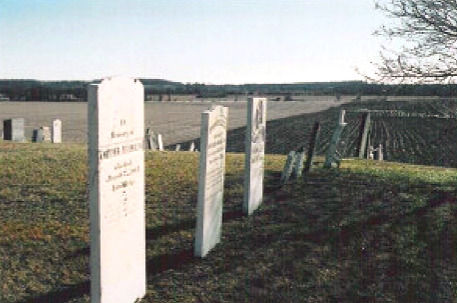
Wahington Ontario Cemetary (photo by June Flath)
They march up over the side of a lone hill in rows of military precision. A bitter wind whisks away the meager offerings of heat from the January sun and these markers stand seemingly abandoned. But the residents of this small cemetery along Highway 97, their names permanently carved in stone are not forgotten.
They lived their lives, buried their children, gossiped at Dunn’s grocery store, the Farmer’s Inn, or the Temperance Tavern and today local historian Jenny Harvey has set out to ensure that their stories, the tales and legends that make up the history of the small village of Washington in Oxford County are recorded for future generations.
The overflowing binders on her dining room table stand as testament to local interest in this earlier time. Washington, according to the Oxford and Brant counties historical atlas of 1876 is reported to be a
“small village on the middle-town-line in the 12th and 13th concessions. It has a general store and post-office, etc., and inhabitants are engaged in the erection of a temperance hall, and pronounce strongly against the traffic in liquors.”

Historic home in Washington Ontario (photo by June Flath)
Rather than simply record history in a straight line Jenny has attacked the project from the perspective of properties and families, recording family tales and trees, as well as the history of sites along the concession lines that reach back to the earliest days.
Local families have been generous and helpful with their photographs, stories, and information on when homes were erected, who the first occupants were and their successors. The stone homes of the area remain a solid record of the local stone masons. She also has golden treasures to mark her journey.

Jenny Harvey, Washington Ontario Historian (photo by June Flath)
She has maps from one local resident showing the owners of area properties in 1900 and again in 1950. She also has the books from 1859-60 for the local chapter of the Independent Order of Good Templars.
Two of the earliest settlers in the area were Thomas Horner and Thomas Watson who travelled to Blenheim township from New Jersey.
Watson’s uncle had befriended John Graves Simcoe during the Revolutionary War and once Simcoe became governor of Canada in 1792 he encouraged Watson to come to Canada and to bring his friends.
A condition for the grant of Blenheim Township was that Hornor must erect a saw mill to encourage immigration. Once concessions were surveyed Hornor travelled to New York to purchase the machinery needed for his mill. He returned to find Simcoe had been replaced as governor and his successor would not honour the land grant. Hornor went ahead and erected a mill in 1796 near the village of Princeton. His nearest neighbor was at Brantford. In 1806 he added a grist mill and a few years later both mills burned and were not replaced.
The bulk of Washington’s immigrants arrived between 1840-1860, however there is one story which tells of Peter Reesor who arrived shortly after 1800. He had made a six week journey on horseback from Pennsylvania to Ontario looking for a place to settle. He had given up hope of finding anything and was ready to return when a stranger offered him 400 acres of land for his horse, bridle, and saddle. He agreed, signed the deal, and then returned to Pennsylvania on foot, a journey of 500 miles, to collect his family and belongings.
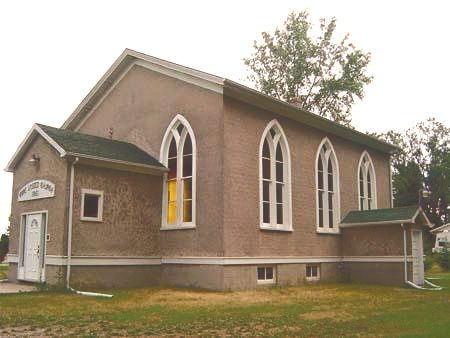
It was during the mid 1800s that the village had its boom years. During this time they supported two general stores, a carriage/wagon works, cheese factory, flax mill, tannery, doctor, two blacksmiths and a post office. The mail arrived in leather bags delivered for a short time by pony express then by stage. It was picked up from the Drumbo store and delivered to Dunn’s General store. In 1846, a Wesleyan Methodist log meeting house capable of holding 150 people was built. A second brick building erected in 1860 still stands.

Historic Methodist Church in Washington Ontario (photo by June Flath)
Squire Tew, in 1859, overcome with generosity, helped finance the Temperance Hotel. He was quoted as saying,
“although not a temperance man now myself, I hope one day to be.”
The need for a Temperance House may have been prompted the year before when the Farmer’s Inn, a licensed establishment, was opened for business.
Diseases swept through the area, one family losing four of their six children in the course of six week from Diphtheria. The community was committed to education and had a log school up and running by 1849. By the 1860s there were 75 children in attendance. They built a sturdy square yellow brick fortress to help expand the childrens’ minds shortly after the turn of the century.
Working on this history, says Jenny, “has been a study in Victoriana.” Newspaper accounts record the death announcement of a young local doctor killed while visiting in Scotland. He left behind a wife and three children ages eight, six and four.
“The dear little things were hourly expecting him, when the sad intelligence of his death arrived.”
Fire destroyed much of the village in 1875. A hot dry summer provided plenty of fuel for a wandering spark from the blacksmith shop and fire raged through the village virtually wiping out the town. Most of the buildings were not rebuilt. The fire coincided with land programs opening the west, encouraging people to follow the setting sun where there was cheap flat land and big skies calling those who still had a sense of adventure in their hearts.


Comments