
The Journey Continues

The winds of change bring new life for Norwich Gore United Church
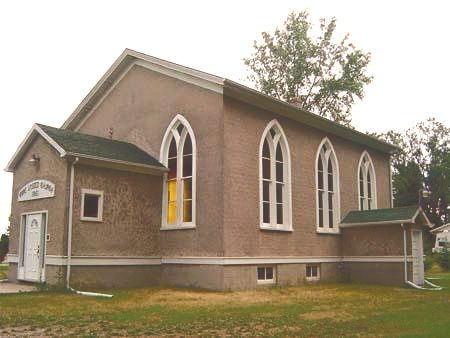
Norwich Gore United Church at it's original location at Base Line road Norwich Township (photo courtesy of Canada's Historic Places)
Nester Kozey has retired three times and sold his equipment twice. He moved his first building sixty years ago and this spring the 84 year old helped relocate the Norwich Gore United Church. The church was moved from Base Line road Norwich Township to the Norwich Museum site on Highway 59.
Every journey starts with a single step and this one started 150 years ago. The community of Norwich Gore was first surveyed in 1833 but records show a group of Episcopal Methodists were holding regular services at Benjamin Hilliker’s home by 1834. Saddle-bag ministers Wills, Smith and Harris traveled from Long Point to Ingersoll sharing gossip, books, and sermons with the members.
In 1859 the congregation decided to build a church and eight members put up $50.00 each to help fund the process while others volunteered time and materials. William Merrill, owner of the local sawmill, is credited with building the church.
The windows Merrill installed would guarantee historic designation for the building. A Regency style construction, the church’s eight, four foot by twelve foot gothic windows allowed for plenty of light during the pre-electric age. The eight panes are opaque pebbled glass, traditionally used so worshippers would not be tempted to stare out of the window.
The history of the Norwich Gore congregation is a study of rural Ontario tracking the arrival of electricity, the digging of a foundation as well as weddings, funerals, women’s groups, young men’s groups, missions, Sunday school, garden parties, and strawberry socials, a record of a community gathering to support, celebrate, and eat. From 1955 until 2003 the church members made home-made candy and sold it at the local fairs in Norwich, Burford, Paris, Simcoe and Tillsonburg and between 1971 and 2003 they also sold homemade chili, sandwiches, and pie at both the Norwich and Paris Historical Steam show. That ended in 2003 when the Department of Health declared all food had to be prepared on church premises.
In 2005 the dwindling congregation held their final service on June 26 and trustees approached the Norwich Museum about taking over the property and the building. Jim Palmer, president of the Norwich Historical Society, says they were simply unable to maintain two separate sites but discussions continued for alternative ways to preserve the building.
Moving the building was suggested and Presbytery approved. For the cost of $1 the Museum gained ownership of the building and the property. “We paid for it with cash,” says Jim Palmer. However moving a building is not cheap or easy. Built for $100 in 1861, it cost over $15,000 to move in 2011. More than half of that cost came from disrupting hydro services. Hydro service for approximately 200 homes was disconnected for three hours on March 7th as the journey was made.

Norwich Gore United Church as it waits for a new foundation, renewed purpose (photo by June Flath)
The community rallied around, just as they did when the building was constructed offering time and skill, this time to help preserve their rural heritage. Discussion about moving a building meant Nestor Kozey’s name came up. Legend has it, and it has been proved again, that a glass of water left on the counter will still be there if Kozey braced, lifted and moved the building. He told Palmer, “I’ve already done two buildings this year, this’ll be my third and that’s just about right.”
They ran beams through the basement windows to brace the building to keep the floor from rising up. The beams were then set on axels and the church lifted off its foundations.
“It was a slow process.”
A crew, including Murray Cornwell, Doug DeMont and Larry Polfliet followed Nestor’s instructions. Since the farmland between the church and the Museum was Cornwell’s farm they decided it might be easier to go cross-country than down the road. Cornwell with the help of Malcolm Excavating of Burgessville created a 25-foot wide road of hard packed snow across his property.

Norwich Gore United Church en route to it's final resting place (photo courtesy of the Norwhich and District Museum and Archives)
In the weeks leading up to the move the most common question organizers had was, “What day?” Everyone wanted to watch. John Rutherford led the parade driving a Case tractor with articulated treads. John and his wife Sandra had been married in the Gore church over fifty years earlier, and the move, like marriage, had a few moments that caused him to pause and think. One spot was a stretch of water six to eight inches deep. The concern was whether there was enough frost in the ground to hold the tractor and the building. But after a brief consultation they kept going and the 2 ½ mile trip took 2 1/2 hours.
Palmer says he thinks the church looks forlorn right now, still on wheels while it waits for the foundation to be completed. And while most breathed a sigh of relief once the building safely reached the Museum site, Nester’s sense of completion won’t happen until the Norwich Gore is safely set down on its new foundation.

To avoid issues of traffic, power lines and for direct route, it was decided to go cross country rather than via roads (photo courtesy of the Norwhich and District Museum and Archives)
Plans for the future include Archival storage, church services, weddings, funerals, recitals, and meetings. The pews remain intact offering space for approximately eighty people and there is a small stage at the front. Says Murray Cornwell everyone wins,
“It’s a bonus for the historical building and for the community.”


Comments