
The Changing Town of Richwood

Updated: Apr 8, 2020
“There is nothing more constant than change itself.”

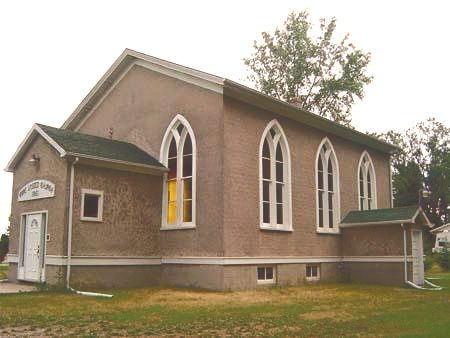
Richwood United Church (photo by June Flath)
The 5th Concession of Blenheim Township is book ended by the Oxford-Brant Town line and the Drumbo-Princeton road. Jake Morrison grew up on this stretch of gravel and working his way from one end of the road to the other he can still see the farms and businesses that made up the rural community of Richwood. These memories and anecdotes have been printed in the booklet, “The Glorious Fifth Down Richwood Way.”
For the Morrison family life along the Fifth began when a tract of clergy land was offered for sale, John Jackson Esquire bought 150 acres paying, 93 pounds 15 shillings. Jackson had been born in County of Armagh, Ireland in 1794, coming to Canada in 1825. He became Reeve of Blenheim and Clerk of the Division Court. Says his descendant, John D Morrison (Jake), “I have a copy of the Grant for this clergy sale which reads, Brock District, recorded 18 September, 1840.”
Jackson had four children. One son was killed while clearing the land; another was hit by a horse-drawn turn-about. One daughter married Dr. John Morrison and the other married Harry Acres, the first principal of Paris High School.
Just down the road from the Morrison family farm flows the Nith River. The bridge over the River Nith in Jake’s youth was a high steel frame structure built in 1912 with cement floor, abutments and pillars on the ends.
“When we heard the bridge was being replaced, we brought four of these pillars home. They make attractive stands for flower pots.”
The river was a gathering place on Sunday afternoons, “I have seen as many as 100 or so people gather at the river, some swimming, a few fishing and a lot just on the bridge visiting. Of course there was “skinny dippin’ but that was done after dark.”
There are other not so pleasant memories related to the bridge and the river.
“One time a man dove from the top of the bridge into the river. Mud and blood came up before he did. His friends pulled him out. He was unconscious, but he came around.”
There were other river casualties. The community men pulled the body of one man out of the water they believed was a traveling salesman. He had left his horse and buggy on the bridge and went into the river. No one ever knew for sure who he was.
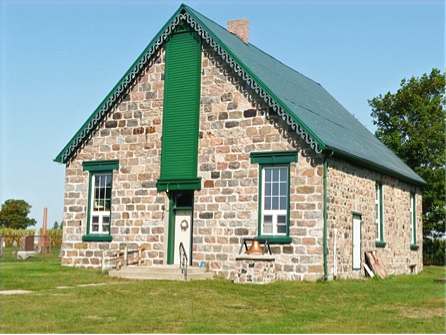
Richwood Public School now used as a community hall (photo by June Flath)
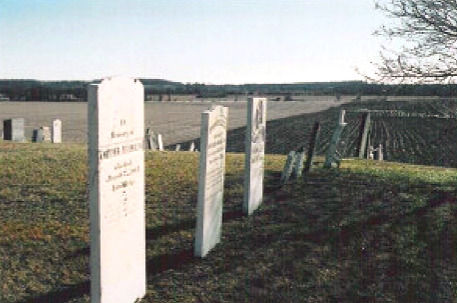
Riverside Baptist church was built in 1828 near the banks of the river. The building is gone but Riverside cemetery still stands marking a place in time for members of the rural congregation.
Jake can still picture the dense woodlot south of Tom Holder’s “next to the railway tracks” and he remembers the hobos and tramps that rode the rails coming up the laneway to ask for a meal.
At the main corner was a post office operated by Grace Dlosz, a railway station, freight station, general store, church and school. Jake can still see them all as they were, vibrant, vital segments that together made a full picture of rural life. Visitors today can only glimpse a shadow of what once was.
There’s no sign of John Summerhayes sawmill, or Emanuel Richardson’s blacksmith shop, “once a very active business,” but Goodwin’s turnip waxing plant still stands if you know where to look and Richwood United Church still supports an active congregation. Just behind it stands the school built in 1857 still in use for meetings and community events. Jake tells of sliding down the coal chute to the furnace, until someone got stuck; perching a pail of water on the door to soak the teacher; inkwells, pumping water by hand, and no bathrooms. The building contained eight grades, 71 students and one teacher.
His memories of the countryside include learning to drive at age fifteen. Early in his driving career he rear-ended a truck when it stopped suddenly at the Drumbo railway tracks. The car slid under the truck just as a passenger train flew by. The second accident happened when he met two sets of headlights coming toward him as he came down Racknor’s Hill. He swerved hoping to avoid a collision.
“The police came and talked and measured while I stood there and shivered in shock, knowing I had just done my father’s car in again.”
Third time’s a charm. Heading in to a dance at the school, “My father let me drive his car again.” Jake drove into Drumbo to pick up his date. Entering the village, “I rolled the window down to flick my cigarette butt out.”
Later that evening, about eleven o’clock, “a man comes to the door yelling, ‘Who owns that grey chev outside? There’s smoke coming out of it!’ Sure enough, it was my father’s car."
"After that my father and I decided I needed my own car. A Model A Ford.”
Jake and his wife, Irene, moved from the farm to Drumbo in 1977 and over the years he’s watched a gradual and complete change in the surrounding countryside but he takes it all in stride, “I find that there is nothing more constant than change itself.”

Comments