

Iron Roads of Oxford County - Beachville

The Great Western Railway was the first railway to roll through Oxford County. The opening of this railway was a steel version of the traditional paths of commerce dating back to the 1790s when commerce moved from Burlington Bay to London. Incorporated as the London and Gore Railroad Co in 1834 this rail line was to join London, Burlington Bay, the Thames River and Lake Huron. It went through several name changes until it was established as the Great Western.
In Oxford County the tracks followed the north bank of the Thames River and the Great Western rumbled through Beachville, Ingersoll, Woodstock, Eastwood, Gobles, Princeton, Tillsonburg and Thamesford. In general, the arrival of the locomotive was perceived as a progressive moment for the area representing the promise of increased economic opportunities and greater interconnection and exchange with the rest of the province.
Beachville, considered by many sources to be the birth place of Oxford county, has settlement roots reaching back to the 1780s when John Carroll arrived from New Jersey. With the end of the American Revolution in 1783, refugees began to arrive at border forts. They brought little but the clothes on their backs. Most stayed under the protection of the forts but those who ventured further afield took with them only a hoe and an axe, a little flour and pork supplies from the regimental stores.
By 1791 the community had been named after Andrew Beach owner of the first grist mill in the area and had a significant enough population to warrant a postal depot. A man on horseback set out every spring travelling from Queenston and stopping in York, Ancaster, Brant’s Ford, Beachville, Chatham, Sandwich and Amherstburg.
Governor Simcoe visited the area in 1793 and shortly after settlers in the area learned that the land they had cleared and called their own had been deeded to Thomas Ingersoll. While Ingersoll began encouraging settlement and widening and improving the trails through the woods, local residents were unhappy with losing their land.
Many of the earliest settlers had no paper trail to prove deed to the land. They squatted, cleared land, built a home and started a life. Making proper application meant a long journey to Niagara-on-the-Lake to take the oath of allegiance and sign a declaration.
Beachville had regular stage service as early as 1832. The roads were muddy rutted trails that ran from Queenston to Chatham and connected with regular lake and river services. Travellers could reach Kingston four days after leaving Chatham using a combination of stage and streamer.
By 1835 there were grist and sawmills, two whisky distilleries, a small tavern and stores. There was a bridge at Cedar creek and a good road along the Thames between Woodstock and Beachville.
At the time the railroad was constructed Beachville was already a busy town. Main roads of the province were paved with three inch planks which took enormous quantities of timber. Local saw mills along the route of the roads did a big business. In 1852 there were six sawmills in West Oxford and two in North Oxford. Many local citizens welcomed the opportunity to make ready cash by working with the teams of horses needed to cart timber or by working on the roads themselves.
The arrival of a rail line was preceded by a multitude of transient workers building those steel ribbons and a station. They were a robust crew and could be exuberant. Marjorie E. Cropp in Beachville The Birth Place of Oxford claims, “The workers of the railway were a rough, lawless lot, mostly transient Irish. Taverns did a roaring business and respectable folk stayed home after dark. In some cases the militia had to be called in to keep order.”
Both during the process of its construction and following its completion, the Great Western Railway ultimately brought a tremendous amount of business, travel and trade to Oxford County. Even before the railway was complete farmers wives made a profit selling meals to the railway workers. Carpenters built large construction camps to accommodate the workers. These camps were usually eight miles apart and eventually became the centre of many villages in Oxford County. In Beachville, the Beachville Railway station became the shipping point for the Embro District as each day grain and other products such as timber, travelled to and from other parts of Ontario.
The Great Western was officially opened on December 15, 1853. “The first train, drawn by its tiny stacked wood burning locomotive travelled the route through town at 6 miles an hour and was decked out with flags and bunting. At each stop and station the community came out to watch the train puff through town.” (History of North Oxford Township)

“It was a gala day for everyone who had gathered from miles around to watch the first train go through. The roar of the wood burning locomotive and the echo of its shrill whistle was music to their ears. They joyfully anticipated all that it would mean in easing the burden of hard, unending toil. Faces of settlers, hitherto harassed by the struggle for a bare existence and lack of even the smallest luxuries, lit up with smiles, and heavy hearts were lightened in the certain hope of a better future for themselves and their children.” (Marjorie E. Cropp, Beachville: The Birthplace of Oxford 1973)
It was not always smooth sailing for these steel galleons. A week after its inaugural journey a train going east was wrecked at Copetown and the fireman injured. Two days later coming west, it broke down at Grimsby. In the first nine months of operation there were a recorded fifteen collisions between freight and passenger trains. There were some bugs to iron out of the process. (Birth place of oxford)
For many years a watchman was hired to man the crossing at Beachville. He lived in a small house south of the tracks on the east side. In storms or calm weather, day or night, he went out with a flag or a lantern to regulate the traffic for every train that passed. Watchmen included: Mrs. Mason, Mr. William Lightheart and Mrs. Harm Cook.
The export of timber was a booming business at this time. Oak staves for barrels were shipped to Quebec, while white pine was rafted across Lake Erie for manufacturers in the United States. Great rafts two miles in length consisting of uncut logs were a common sight on the lake. Long lines of teams carried timber for export to the nearest ports. Once the railway went through great quantities of cord-wood had to be available at regular intervals along the route in order to replenish the wood needed to power the steam engines.
Prior to the railway, people came to Beachville to shop because there was a greater variety of stores than in Woodstock and Ingersoll. While the Beachville community survived the building of three railways there was not room on the Beachville flats for extensive railway yards and Woodstock took that role and began to grow.
Sutherland’s Gazetteer for 1862-1863 states: “This village is prettily situated on the banks of the River Thames, five miles west of Woodstock, and on the line of the Great Western Railway, of which it is a station. It is in the midst of a rich agricultural district, being surrounded by splendid cultivated farms. There is ample water power in this vicinity for mills and factory purposes. The London and Hamilton macadamized road passes through the village. It has a daily mail service, and contains two churches, Episcopal and Presbyterian, other denominations use the school house. It also contains a flouring and grist mill, two saw mills, foundry and machine shop, two blacksmiths shops, a wagon and carriage factory, fanning mill factory, vinegar factory and tannery, four hotels, six general stores, tin shop and cabinet shop, besides other representations of the various mechanical trades. During the last summer this village suffered a serious loss by fire of a large and extensive barrel factory where a number of operatives were employed. Population 400.”
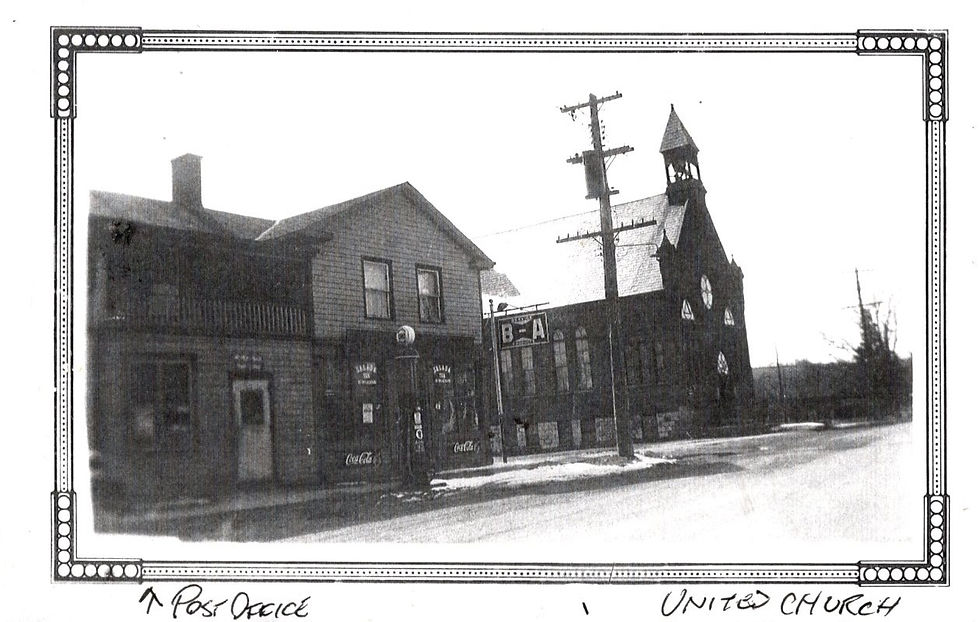
In 1875 the Great Western expanded its line by entering into agreement or by financing other railway lines throughout southern Ontario. In 1882 The Great Western and the Grand Trunk Railway merged under the name Grand Trunk Railway. After adding several branches of rail, in 1923, the Grand Trunk Railway was amalgamated into the Canadian National Railway.
The original Great Western station was constructed with the opening of the line in 1853. This building was replaced in 1904 by a new station constructed by the Grand Trunk Railway. It was a single storey frame structure with a decorative hip roof that incorporated a corner two storey tower feature above the waiting room, and a rounded operator window topped by a rounded dormer. It contained a general and ladies passenger waiting rooms, ticket/operator office, and a large freight and baggage room.

CNR closed the Great Western station in 1973, tenders were taken to remove the building that had been the centre of grain and oatmeal industry, plus shipping point for limestone industry.
In 1871 a charter for the Credit Valley Railway was secured to enable the construction of a railway from Toronto to St. Thomas which would connect to the Michigan Central Railway. By 1878, The Credit Valley was built between Ingersoll and Woodstock and also had stations in Centreville and Beachville. This was the second railway to pass through the village of Beachville and this line between Woodstock and Ingersoll proved to be successful in the late 1880s. Shortly after opening, the Credit Valley was advertised as being the new and popular short line between the east and the west of southern Ontario. In 1883 the Credit Valley was absorbed into the transcontinental Canadian Pacific railway line.
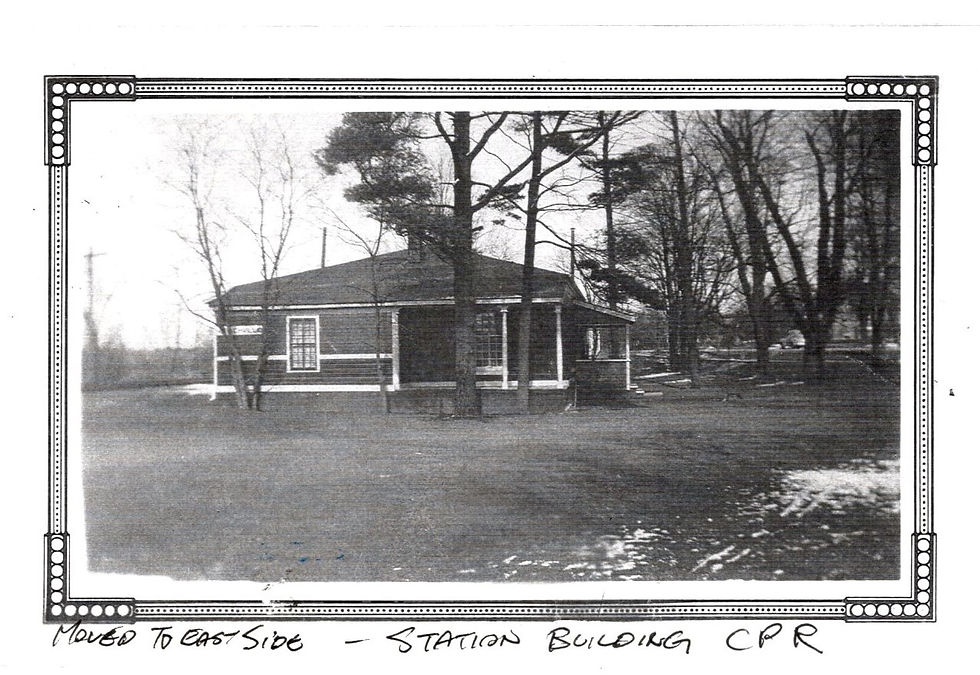
The Credit Valley station had been located on the east side of Zorra Line, County Road 11 north of the Beachville Road. According to local sources several main street business were either moved or torn down to accommodate the building of the Credit Valley line. “One building, a beautiful residence with well kept grounds was bought and moved forward and was used as a combined station and home for the station master.”
Mr. Shepherd moved from Ingersoll to Beachville to become the first station master. After his death, his daughter May took over and she continued in the post until her death in 1947. The station was then closed. The building is believed to have been relocated and used as a private residence on County Road 9.
The Woodstock, Thames Valley and Ingersoll Electric Railway ran from 1900-1925.
Trains ran along the south side of Beachville Rd. Railway cars would stop at the intersection of Beachville Rd and Martin St/Zorra Line to embark and disembark passengers. To the east of Beachville past East Hill Line, the company established a park known as Fairmount Park (named for the park of the same name in Philadelphia). Directly across was Riverside Park, a private park that featured boathouses on the Thames River.
Constructed as an interurban electric rail line the WTV&IER was the smallest interurban line built in Canada. Originally, the project was viewed as being a link between similar lines then being planned to connect the major centres of Toronto, Hamilton and London.
The charter was first enacted in 1900 by the Von Echa Company, an American firm. Construction was initiated immediately with the line being open for traffic between Woodstock and Beachville in November of that same year. The complete route was completed into Ingersoll by 1901. The line was built beside the highway on the south side of the Thames River while in Woodstock proper, the railway meandered along various streets.
Operation consisted primarily for passengers. While the line never lost money, receipts were barely high enough to cover expenses with little left over for maintenance and upgrading. As a result, Von Echa bailed out, leaving the line to bondholders in 1915. Operation carried on until 1925 when it was decided to abandon the line entirely. All infrastructure was immediately dismantled and scrapped.

These stations have long since been removed. They exist only on faded maps where a small rectangle marks the place where people gathered their laughter and tears drifting across time along with the echoing whistle of the train.
(Historic photos with thanks to the Beachville Museum)


Comments